Apparently we had 3 nesting Wood Ducks here at Horn Pond this spring! Male Wood Ducks, (males are called drakes) like their bigger cousins, the Mallards, take off after doing the deed!! Mom is left to raise the ducklings on her own. And these moms are doing a pretty good job! We have a family of 4, a family of 7 and a family of 9! For some reason, the bigger Mallards don’t like the little Wood Ducks. Any pet Psychiatrists out there? All three families were over in the Cattail Marsh, the corner nearest the Red Bridge. I spent a pleasant hour photographing the three broods as they swam back and forth between an open area along the "sewer-line trail", the cattails to the left of the opening and the end of the Marsh covered with duckweed.


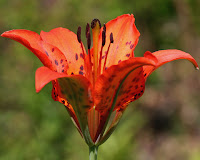
Normally, around the 4th of July, a lovely little wildflower called the Philadelphia Wood Lily can be found on Horn Pond Mountain. It is a delicate, upward facing orange to red-orange lily that grows on the side of the mountain under the High-Tension wires. The plants are short, single stems with whorls of leaves and usually a single flower on top. Occasionally there will be two flowers. Don’t know if it is the heavy rains or the heavy plant growth (probably caused by the heavy rains) that is the cause, but there were no lilies to be found this year!! I’m very disappointed! I have been photographing these lovely little flowers for years. This is one of the photos I took in 2007.
Park your car at Ice House Park on Sturgis Street and take a walk across the Causeway on your way to the Mountain. As you walk along the water look for the blue spikes of Pickerel Weed along the Lagoon side of the Causeway. On a hot day you might see dozens of Dragonflies among these native plants. Do you know how to tell the difference between a Dragonfly and a Damselfly? When they lite on a flower the Dragonfly holds its wings out flat, perpendicular to its body. The Damselfly folds its wings back parallel to its body.


Look for the Great Blue Heron as you walk along. He can very often be found somewhere in the Lagoon. This day he was in the corner, just a little ways along the dirt road.


Another day I found this rather oddly patterned Eastern Painted Turtle in the same corner.
And on the Causeway side of this corner is where you find the native pink Swamp Rose. It bloomed rather late this year. It usually is out full by the end of June but it didn’t even start blooming until the middle of July this year.


If you are walking in the morning you might see some of the blue flowers of the Chicory. Its blooms are only open in the morning. Its roots can be dried, roasted and ground and used as a coffee substitute. It has no caffeine and is often added to coffee to cut down on the caffeine content.

Also along the Causeway on the Lagoon side, look for Purple Milkweed. Unlike the Common Milkweed, these flowers are an intense purple-pink and bloom a little later than Common Milkweed.


I like to climb up the front of the Mountain under the High Tension wires, and come down the old access road. I just find it easier going up on the loose rubble of the trail then coming down on loose rubble. Just personnel preference! It is under these wires, out in the full sun, that the Philadelphia Wood Lily usually grows. But there are other flowers here to look at! Two woody-stemmed plants that grow along this trail are Meadowsweet and Steeplebush. These two members of the Rose family are both native wildflowers and both can be found in many places on Horn Pond Mountain. Meadowsweet can be white or pale pink and Steeplebush is a deep pink.


There are plenty of other wildflowers in bloom, however, on the mountain and elsewhere around Horn Pond.
Park your car at Ice House Park on Sturgis Street and take a walk across the Causeway on your way to the Mountain. As you walk along the water look for the blue spikes of Pickerel Weed along the Lagoon side of the Causeway. On a hot day you might see dozens of Dragonflies among these native plants. Do you know how to tell the difference between a Dragonfly and a Damselfly? When they lite on a flower the Dragonfly holds its wings out flat, perpendicular to its body. The Damselfly folds its wings back parallel to its body.


Look for the Great Blue Heron as you walk along. He can very often be found somewhere in the Lagoon. This day he was in the corner, just a little ways along the dirt road.


Another day I found this rather oddly patterned Eastern Painted Turtle in the same corner.

And on the Causeway side of this corner is where you find the native pink Swamp Rose. It bloomed rather late this year. It usually is out full by the end of June but it didn’t even start blooming until the middle of July this year.

Some tall flowers you can find at the water’s edge are Water Hemlock, a member of the carrot family, with its Queen Anne’s Lace look-a-like flower-head, and Tall Meadow Rue with its fluffy heads of cream colored, starry flowers.


If you are walking in the morning you might see some of the blue flowers of the Chicory. Its blooms are only open in the morning. Its roots can be dried, roasted and ground and used as a coffee substitute. It has no caffeine and is often added to coffee to cut down on the caffeine content.

Also along the Causeway on the Lagoon side, look for Purple Milkweed. Unlike the Common Milkweed, these flowers are an intense purple-pink and bloom a little later than Common Milkweed.

Walk straight past Lions Park on the back road to the Mountain. The Golf course will be on your right. Just after the golf course, look for tiny pink flowers in the grass. These are Deptford Pinks, a Dianthus of European origin. The flowers are tiny, only about ½" across, but easy to spot as they are bright hot pink!

I like to climb up the front of the Mountain under the High Tension wires, and come down the old access road. I just find it easier going up on the loose rubble of the trail then coming down on loose rubble. Just personnel preference! It is under these wires, out in the full sun, that the Philadelphia Wood Lily usually grows. But there are other flowers here to look at! Two woody-stemmed plants that grow along this trail are Meadowsweet and Steeplebush. These two members of the Rose family are both native wildflowers and both can be found in many places on Horn Pond Mountain. Meadowsweet can be white or pale pink and Steeplebush is a deep pink.


Other wildflowers I found on this side of the mountain are the mid-western Black-eyed Susans, the fuzzy pale pink Eurasian import Rabbit-Foot Clover, the native bright pink Field Milkwort, the native Spreading Dogbane with its little pink bell-shaped flowers, the native yellow Wild Indigo and surprisingly, out in the sun, the little native Woodland Sunflower.


Check out the great view of Horn Pond when you get to the top!


With all the rain we have had, the old reservoir has quite a bit of water in it. Cattails grow here and Dragonflies are plentiful.


As you come down the other side on the old access road you will see different flowers in the woods. The woods around Horn Pond are Dry Oak-Hickory woods. The native Spotted Wintergreen can be found in these woods as well as the woods to the North of the Lagoon. Indian Pipes are also native but they have no chlorophyll so must get their nutrients from organic matter in the soil. Back out in the sun at the bottom of the mountain I ran into a tiny little Cabbage White butterfly on some Spotted Knapweed, both alien species!


As I walked by the Cove, one of our three Mute Swan families was right on the shore. Two of the four Cygnets in this family are white and have been since they hatched. These are "sports", or genetic mutations, and are usually female.

I hope you are all getting out and enjoying Horn Pond in between all the rain we have been having! It is truly a wonderful place to live!
Stay tuned for a blog about my new camera and some fabulous shots, taken at Horn Pond, of course!!!